
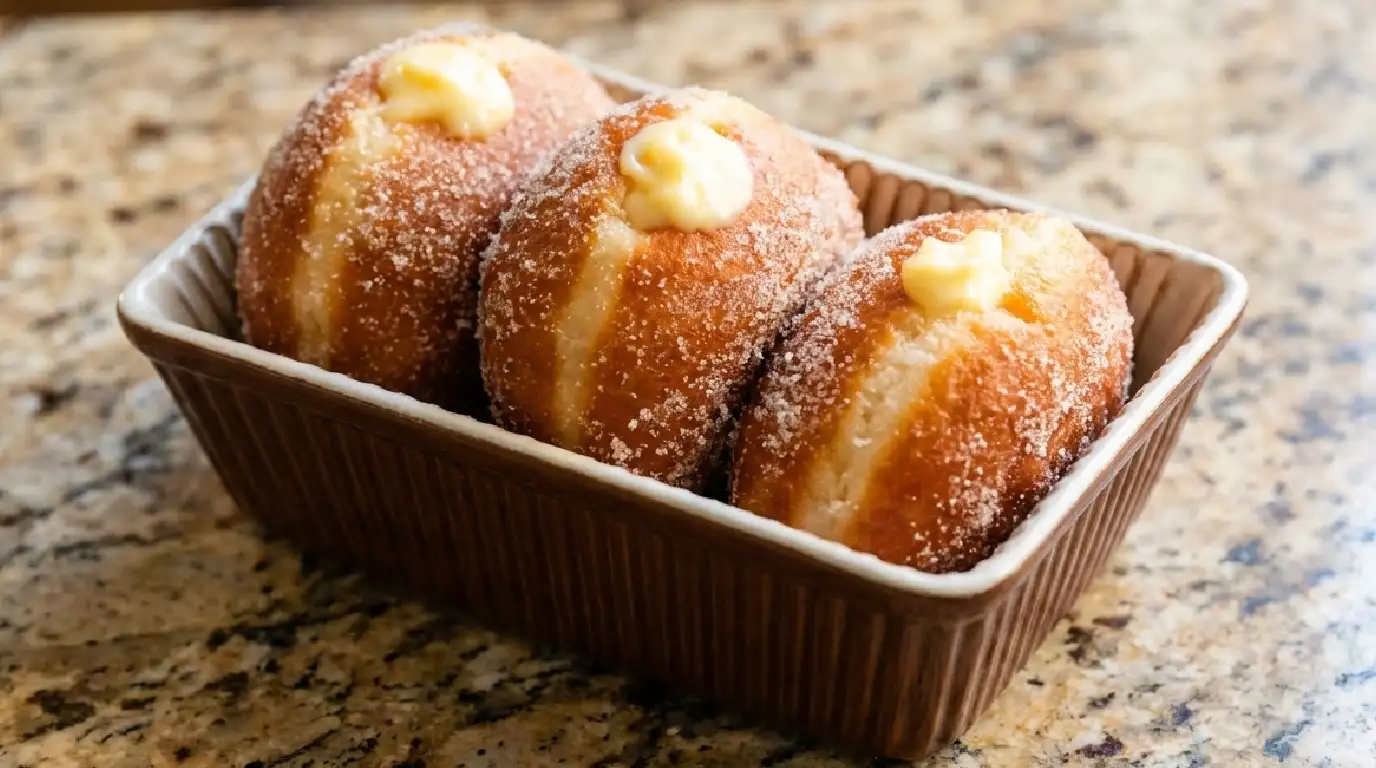
Bomboloni Recipe: Soft, Pillowy Italian Doughnuts You’ll Make on Repeat
There’s a bakery in Florence I used to walk past every morning, and the smell hit you before you even saw the door. Warm sugar, hot oil, something buttery baking just out of sight. That smell is bomboloni. Round, golden, dusted heavy with sugar, and filled with something creamy that oozes out the second you bite in.
Bomboloni are Italy’s answer to the doughnut, but calling them “just a doughnut” undersells them a little. The dough is enriched with eggs and butter, so it fries up tender and almost custardy inside, with a crust that’s barely there. Traditionally you’ll find them plain, rolled in sugar, or stuffed with pastry cream, jam, or chocolate. I make a version stuffed with vanilla bean pastry cream because once you’ve had a warm one leaking cream down your fingers, there’s no going back to the empty kind.
This recipe walks through the whole process: the soft enriched dough, the slow rise that makes all the difference, the fry, and a simple pastry cream filling. None of it is hard. It just takes a little patience.
Why You’ll Love This
- The dough is soft and slightly sweet, closer to brioche than to a standard doughnut, so the texture stays tender even after they cool
- You control the filling, whether that’s classic vanilla pastry cream, Nutella, jam, or nothing at all
- They fry up fast, just a couple minutes per batch, so a full tray comes together quicker than you’d expect
- The smell alone will pull everyone into the kitchen before the first batch is even drained
- They’re genuinely better than most bakery doughnuts, and that’s not an exaggeration once you taste one fresh
The Backstory
My mother-in-law is not an easy audience when it comes to dessert. She trained in a proper Italian kitchen decades ago and has strong, quiet opinions about anything fried, anything sweet, and especially anything claiming to be authentic. The first time I made bomboloni for a family lunch, I didn’t tell her what they were until she’d already eaten one. She went quiet for a second, wiped a bit of sugar off her lip, and asked where I’d learned to laminate the dough properly. I hadn’t laminated anything. I just let it rise long enough. She had a second one before the plate even made it around the table, and now she asks for them every time we visit.
What Makes It Special
- Eggs and butter in the dough give bomboloni their rich, almost custardy crumb, setting them apart from lighter, drier doughnuts
- Whole milk keeps the dough soft and helps the yeast do its job without drying anything out
- Granulated sugar, both in the dough and for the final coating, adds that classic sandy crunch on the outside
- Vanilla bean or good vanilla extract in the pastry cream brings a warm, floral sweetness that plain custard powder never quite matches
- Neutral frying oil, like sunflower or peanut oil, keeps the flavor clean so the dough and filling stay front and center
Making It Happen
Start by warming the milk gently, just until it’s lukewarm, then whisk in the yeast and a spoonful of sugar and let it sit until foamy. This tells you the yeast is alive before you commit the rest of your ingredients to it. In a large bowl or stand mixer, combine the flour, remaining sugar, and a pinch of salt, then add the eggs, softened butter, and the foamy yeast mixture. Knead until you’ve got a smooth, elastic dough that’s tacky but not sticky, which usually takes about ten minutes by machine or a bit longer by hand.
Cover the dough and let it rise somewhere warm until it’s doubled, roughly an hour, though a slightly cooler kitchen just means a longer wait, not a failed dough. Once risen, roll it out on a lightly floured surface to about half an inch thick and cut rounds with a biscuit cutter. Place them on parchment squares, cover loosely, and let them rise again until puffy, about 30 to 45 minutes. This second rise is what gives you that light, airy interior instead of something dense.
While they rise, make the pastry cream: whisk egg yolks, sugar, and cornstarch together, then slowly pour in hot milk that’s been infused with vanilla. Cook the mixture over medium heat, stirring constantly, until it thickens into a smooth custard. Press plastic wrap directly onto the surface and chill it while the dough finishes proofing.
For frying, heat your oil to 340–350°F. Slide the dough rounds in a few at a time, parchment and all, peeling the paper off once they release. Fry for about a minute and a half per side, until deeply golden. Drain on paper towels, then toss the warm doughnuts in granulated sugar immediately so it sticks. Once cooled slightly, use a piping bag fitted with a narrow tip to fill each one generously with the chilled pastry cream.
You Must Know
- Don’t rush either rise. A slow, full rise is what makes the crumb soft instead of tough or bready
- Keep your oil temperature steady. Too hot and the outside burns before the inside cooks; too cool and they soak up oil and turn greasy
- Fry in small batches so the oil temperature doesn’t drop too much at once
- Sugar the doughnuts while they’re still warm, since sugar won’t stick well once they cool
- Let the pastry cream chill fully before piping, or it’ll be too loose to hold its shape inside the doughnut
Serving Ideas & Pairings
Bomboloni are best eaten warm, ideally within an hour or two of frying. A strong espresso or a cappuccino is the classic pairing, cutting through the sweetness the way it’s meant to. For a weekend brunch spread, set them out alongside fresh fruit and a pitcher of cold orange juice, or serve a few plain ones with a bowl of extra pastry cream and berries for dipping.
Make It Different
Swap the vanilla pastry cream for a quick chocolate version by melting dark chocolate into the finished custard while it’s still warm. Jam-filled bomboloni work beautifully too; just warm the jam slightly so it pipes smoothly. For a dairy-free dough, plant-based milk and vegan butter work fine, though the crumb will be a touch less rich. If you want to skip filling altogether, a light dusting of cinnamon sugar instead of plain sugar gives you a simpler, no-fuss version that’s just as good with morning coffee.
Storage & Reheating
Unfilled bomboloni keep at room temperature in an airtight container for a day, though they’re really at their best the day they’re made. Filled ones should go in the fridge because of the custard, and they’ll keep for about two days. To bring them back to life, a few seconds in the microwave softens the dough nicely, though the sugar coating will lose some of its crunch. If you’re planning ahead, fry and cool the doughnuts, then freeze them unfilled; thaw, warm gently, sugar them fresh, and fill just before serving.
Success Tips
Weigh your flour if you can, since too much makes the dough stiff and the doughnuts dense. Keep an eye on your yeast’s expiration date too; tired yeast means a slow, weak rise no matter how long you wait. When rolling out the dough, use a light touch and avoid reworking the scraps too many times, or the doughnuts made from re-rolled dough will turn out noticeably tougher than the first batch. And resist the urge to fill them while they’re piping hot, since the residual heat can thin out the pastry cream and make a mess.
Frequently Asked Questions
Can I bake bomboloni instead of frying them? You can, but the texture changes quite a bit. Baked versions come out more like a soft bread roll rather than the crisp-edged, tender bite you get from frying. If you’re avoiding deep frying, it’s a fair trade-off, just don’t expect the exact same result.
Why did my dough not rise properly? Usually it’s either the yeast (check it’s fresh and your milk wasn’t too hot when you added it) or the room temperature (too cold slows things down significantly). Give it more time in a warmer spot before assuming something’s wrong.
Can I make the dough ahead of time? Yes. After the first rise, you can refrigerate the dough overnight, punch it down, then let it come to room temperature and continue with rolling and the second rise the next day.
What oil is best for frying bomboloni? A neutral oil with a high smoke point works best, like sunflower, vegetable, or peanut oil. Avoid strongly flavored oils like olive oil, since they’ll compete with the delicate flavor of the dough.
Why are my bomboloni greasy instead of light? This almost always comes down to oil temperature. If the oil is too cool, the dough absorbs oil instead of frying quickly, leaving them heavy and greasy. Use a thermometer and keep the oil between 340–350°F throughout frying.
Recipe Card Info
Prep time: 40 minutes (plus 1.5 hours rising) Cook time: 20 minutes Total time: About 2 hours 30 minutes Servings: 14 doughnuts Category: Dessert, Breakfast Difficulty: Intermediate Cuisine: Italian Yield: 14 filled bomboloni
Equipment:
- Stand mixer (or large bowl for hand kneading)
- Rolling pin
- Round biscuit cutter
- Deep pot or Dutch oven
- Candy/frying thermometer
- Piping bag with narrow tip
- Wire rack or paper towels
Ingredients
For the dough
- 4 cups all-purpose flour
- 1/3 cup granulated sugar
- 2 1/4 teaspoons active dry yeast (1 packet)
- 3/4 cup whole milk, lukewarm
- 3 large eggs
- 6 tablespoons unsalted butter, softened
- 1/2 teaspoon salt
- 1 cup granulated sugar, for coating
For the pastry cream filling
- 2 cups whole milk
- 1 vanilla bean (or 2 teaspoons vanilla extract)
- 5 egg yolks
- 2/3 cup granulated sugar
- 1/3 cup cornstarch
- 2 tablespoons unsalted butter
For frying
- Neutral oil (sunflower, vegetable, or peanut), enough for 2–3 inches depth
Directions
- Warm the milk until lukewarm, whisk in yeast and a spoonful of sugar, and let sit until foamy, about 10 minutes.
- Combine flour, remaining sugar, and salt in a large bowl or stand mixer. Add eggs, softened butter, and the yeast mixture. Knead until smooth and elastic, about 10 minutes.
- Cover and let rise in a warm spot until doubled, about 1 hour.
- Roll dough to 1/2 inch thickness and cut into rounds. Place on parchment squares, cover, and let rise again until puffy, 30–45 minutes.
- Meanwhile, make the pastry cream: whisk egg yolks, sugar, and cornstarch. Slowly whisk in hot vanilla-infused milk, then cook over medium heat, stirring constantly, until thickened. Stir in butter, cover with plastic wrap touching the surface, and chill.
- Heat oil to 340–350°F. Fry dough rounds in small batches, about 1.5 minutes per side, until deeply golden.
- Drain briefly, then toss immediately in granulated sugar while warm.
- Once slightly cooled, pipe chilled pastry cream into each doughnut through a small hole in the side.
Notes
- For a lighter finish, doughnuts can be rolled in cinnamon sugar instead of plain sugar.
- Leftover pastry cream can be served on the side for dipping.
- Dough can be refrigerated overnight after the first rise for a make-ahead option.
Nutrition (per filled doughnut, approximate)
- Calories: 240
- Fat: 10g
- Saturated Fat: 4g
- Carbohydrates: 32g
- Sugar: 14g
- Protein: 5g
- Cholesterol: 85mg
- Sodium: 90mg
