
Vanilla Cake with Dulce de Leche Recipe That Tastes Like Someone’s Grandmother Made It
Introduction
There’s a particular smell that fills a kitchen when vanilla cake batter hits a hot oven — warm, sweet, a little like toasted sugar and butter mingling together. I still remember the first time I paired that classic golden vanilla cake with a thick swirl of dulce de leche. It wasn’t planned. I had a half-used jar of dulce de leche sitting in my fridge from a failed empanada experiment, and on a whim, I spread it between two warm cake layers instead of frosting. The caramel sank slightly into the crumb, turned sticky at the edges, and by the time I took my first bite, I knew this wasn’t going back to being “just vanilla cake” ever again.
This vanilla cake with dulce de leche recipe brings together a soft, buttery crumb and that deep, milky caramel flavor that dulce de leche is known for. It’s simple enough for a Tuesday afternoon but special enough to serve at a birthday table. And once you taste how the caramel seeps into the sponge, you’ll understand why this combination has such a devoted following across Latin American baking traditions.
Why You’ll Love This
- The vanilla sponge stays tender and moist for days, even without added syrups.
- Dulce de leche does double duty as filling and frosting, so there’s less fuss and fewer dishes.
- It uses pantry staples — no obscure ingredients or last-minute grocery runs.
- The flavor gets better on day two, making it an ideal make-ahead dessert.
- It’s forgiving for beginner bakers, with wide margins for error in mixing and baking time.
The Backstory
My mother-in-law is, by her own admission, “not a cake person.” She finds most cakes too sweet, too dry, or too fussy, and she usually pushes dessert around her plate rather than eating it. The first time I brought this vanilla cake with dulce de leche to a family lunch, I didn’t expect much. She took a small polite slice, the kind meant to be left mostly untouched. Ten minutes later, she was back at the counter, quietly cutting a second piece and trying to look casual about it. She later admitted the caramel reminded her of a cake her own grandmother used to make in Argentina, minus the fussy technique. That’s the moment I knew this recipe had staying power beyond my own kitchen.
What Makes It Special
- Dulce de leche — the star ingredient, offering deep caramel notes with a smoky undertone from slow-cooked milk and sugar.
- Real vanilla extract — brings warmth and roundness to the batter, balancing the richness of the caramel.
- Buttermilk — keeps the crumb tender and slightly tangy, cutting through the sweetness.
- Unsalted butter — creamed properly, it gives the cake its buttery, golden structure.
- A touch of salt — sharpens the caramel flavor and keeps the cake from tasting flat.
Making It Happen
Start by creaming the softened butter with sugar until the mixture turns pale and fluffy — this step matters more than people think, since it’s what gives the cake its light texture. Once that’s done, add the eggs one at a time, letting each one fully incorporate before adding the next, followed by the vanilla extract.
In a separate bowl, whisk together the flour, baking powder, and salt. Add this dry mixture to the butter mixture in three parts, alternating with the buttermilk, starting and ending with the flour. Mix just until combined; overmixing at this stage is what turns a tender cake into a dense one.
Divide the batter evenly between two prepared cake pans and bake until the tops turn golden and a toothpick comes out clean. Let the cakes cool in their pans for about ten minutes before turning them out onto a wire rack to cool completely — this patience pays off, since a warm cake will melt the dulce de leche filling too quickly.
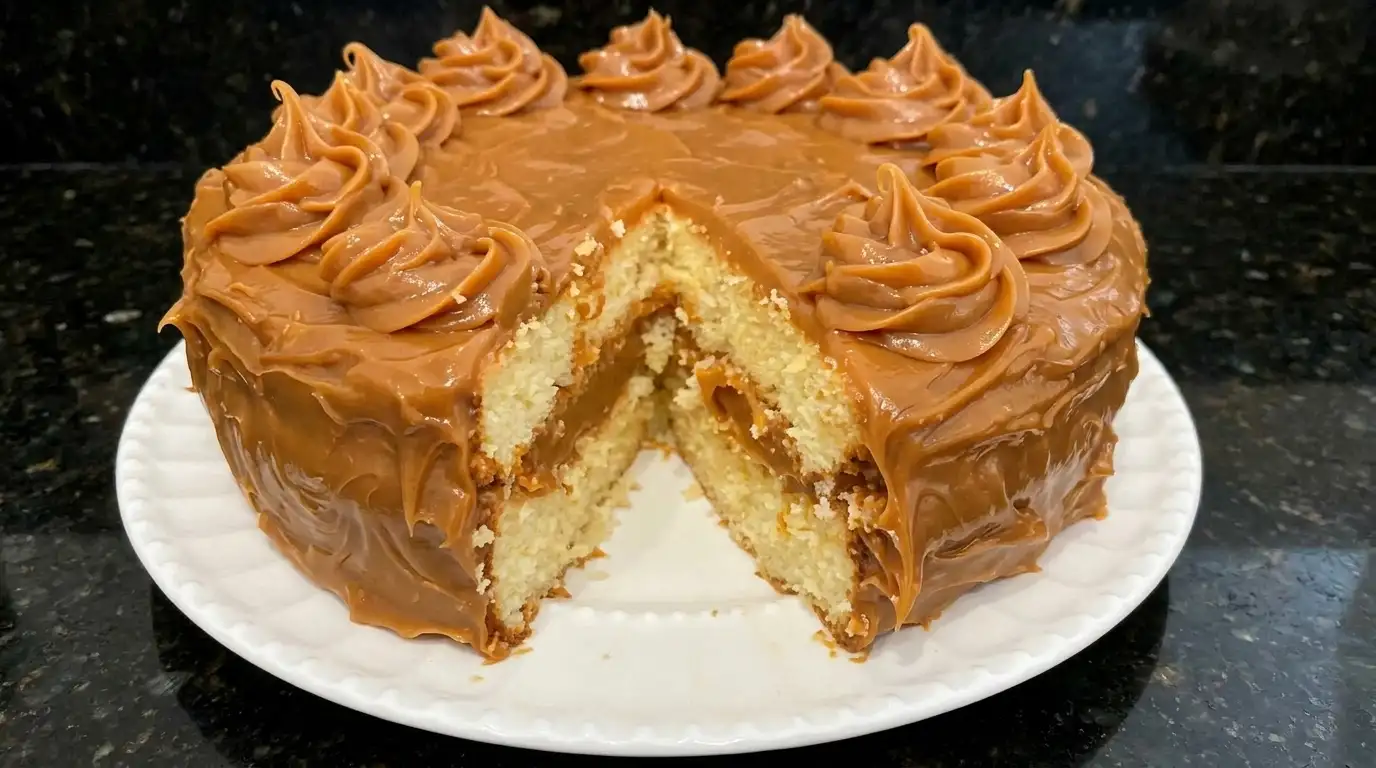
Once cooled, spread a generous layer of dulce de leche over the first cake layer, letting it reach almost to the edges. Stack the second layer on top and cover the whole cake with more dulce de leche, smoothing it into soft peaks and swirls with the back of a spoon or an offset spatula.
You Must Know
- Room-temperature butter, eggs, and buttermilk blend far more evenly than cold ingredients, so plan ahead.
- Don’t overbake — a few extra minutes can dry out an otherwise tender crumb.
- If your dulce de leche is very thick, warm it slightly in a bowl set over hot water so it spreads without tearing the cake.
- Let the cake cool fully before frosting, or the caramel will slide right off.
- A serrated knife works best for leveling cake layers if they’ve domed while baking.
Serving Ideas & Pairings
This cake pairs beautifully with a strong cup of coffee or a mate, which is traditional in many households where dulce de leche desserts are a staple. For something cooler, try it alongside a scoop of vanilla or dulce de leche ice cream. A light, unsweetened whipped cream on the side also balances the richness nicely if you’re serving generous slices.
Make It Different
- Swap the vanilla extract for almond extract for a slightly nuttier, more fragrant cake.
- Add a thin layer of toasted chopped walnuts or pecans between the cake and the caramel for crunch.
- For a chocolate twist, drizzle melted dark chocolate over the finished cake before serving.
- To make it dairy-free, use a plant-based butter substitute and coconut milk in place of buttermilk, along with a dairy-free dulce de leche alternative.
- For individual portions, bake the batter in a muffin tin and fill each cupcake with a spoonful of dulce de leche in the center.
Storage & Reheating
Store the finished cake in an airtight container at room temperature for up to two days, or in the refrigerator for up to five days if your kitchen runs warm. Bring refrigerated slices back to room temperature before serving, since the dulce de leche firms up when chilled and tastes best soft. This cake does not need reheating, but if you’d like the caramel to turn glossy and soft again, a few seconds in the microwave per slice does the trick.
Success Tips
Weigh your flour rather than scooping it directly from the bag, since packed flour can throw off the texture of the whole cake. If your kitchen is humid, your dulce de leche may spread more loosely, so chill it briefly before frosting for better control. And if you want cleaner slices, run your knife under hot water and wipe it dry between cuts — the caramel layer tends to drag if the blade isn’t warm.
Frequently Asked Questions
Can I use store-bought dulce de leche instead of making my own? Yes, absolutely. Store-bought dulce de leche works perfectly here and saves a lot of time. Just make sure it’s a thick, spreadable consistency rather than a thin syrup.
Why did my cake turn out dense instead of light? This usually happens from overmixing the batter once the flour is added, or from butter and sugar that weren’t creamed long enough at the start. Both steps directly affect how airy the crumb turns out.
Can I make this cake ahead of time for a party? Yes, this cake actually tastes better the next day, once the layers have had time to absorb some of the caramel. Just store it covered at room temperature or in the fridge.
Is there a way to make this recipe gluten-free? You can substitute a one-to-one gluten-free flour blend for the all-purpose flour. The texture will be slightly denser, but the flavor holds up well.
What’s the difference between dulce de leche and caramel? Dulce de leche is made by slowly cooking sweetened milk until it thickens and turns golden brown, giving it a milky, almost toffee-like flavor. Traditional caramel is made from cooked sugar alone, so it tends to taste sharper and less creamy in comparison.
Recipe Card Info
Prep time: 25 minutes Cook time: 35 minutes Total time: 1 hour, plus cooling time Servings: 12 Category: Dessert Difficulty: Easy to Moderate Cuisine: Latin American-inspired Yield: One 2-layer, 9-inch cake
Equipment:
- Two 9-inch round cake pans
- Electric mixer (stand or hand)
- Mixing bowls
- Wire cooling rack
- Offset spatula
Ingredients: For the cake:
- 2 1/2 cups all-purpose flour
- 2 1/2 teaspoons baking powder
- 1/2 teaspoon salt
- 1 cup unsalted butter, softened
- 1 3/4 cups granulated sugar
- 4 large eggs, room temperature
- 1 tablespoon pure vanilla extract
- 1 cup buttermilk, room temperature
For the filling and frosting:
- 2 1/2 cups dulce de leche (store-bought or homemade)
Directions:
- Preheat the oven to 350°F (175°C). Grease and flour two 9-inch round cake pans.
- Whisk together the flour, baking powder, and salt in a medium bowl. Set aside.
- In a large bowl, cream the softened butter and sugar together until pale and fluffy, about 3 to 4 minutes.
- Add the eggs one at a time, beating well after each addition. Mix in the vanilla extract.
- Add the dry ingredients in three additions, alternating with the buttermilk, beginning and ending with the flour mixture. Mix just until combined.
- Divide the batter evenly between the prepared pans and smooth the tops.
- Bake for 30 to 35 minutes, or until a toothpick inserted in the center comes out clean.
- Cool the cakes in their pans for 10 minutes, then turn out onto a wire rack to cool completely.
- Once cooled, spread a thick layer of dulce de leche over the first cake layer.
- Place the second layer on top and spread the remaining dulce de leche over the top and sides of the cake.
- Slice and serve at room temperature.
Notes:
If your dulce de leche is too thick to spread easily, warm it gently over a double boiler or in short microwave bursts, stirring often, until it loosens slightly.
Nutrition (approximate, per serving):
Calories: 420, Fat: 18g, Saturated Fat: 10g, Carbohydrates: 58g, Sugar: 40g, Protein: 6g, Sodium: 210mg
