
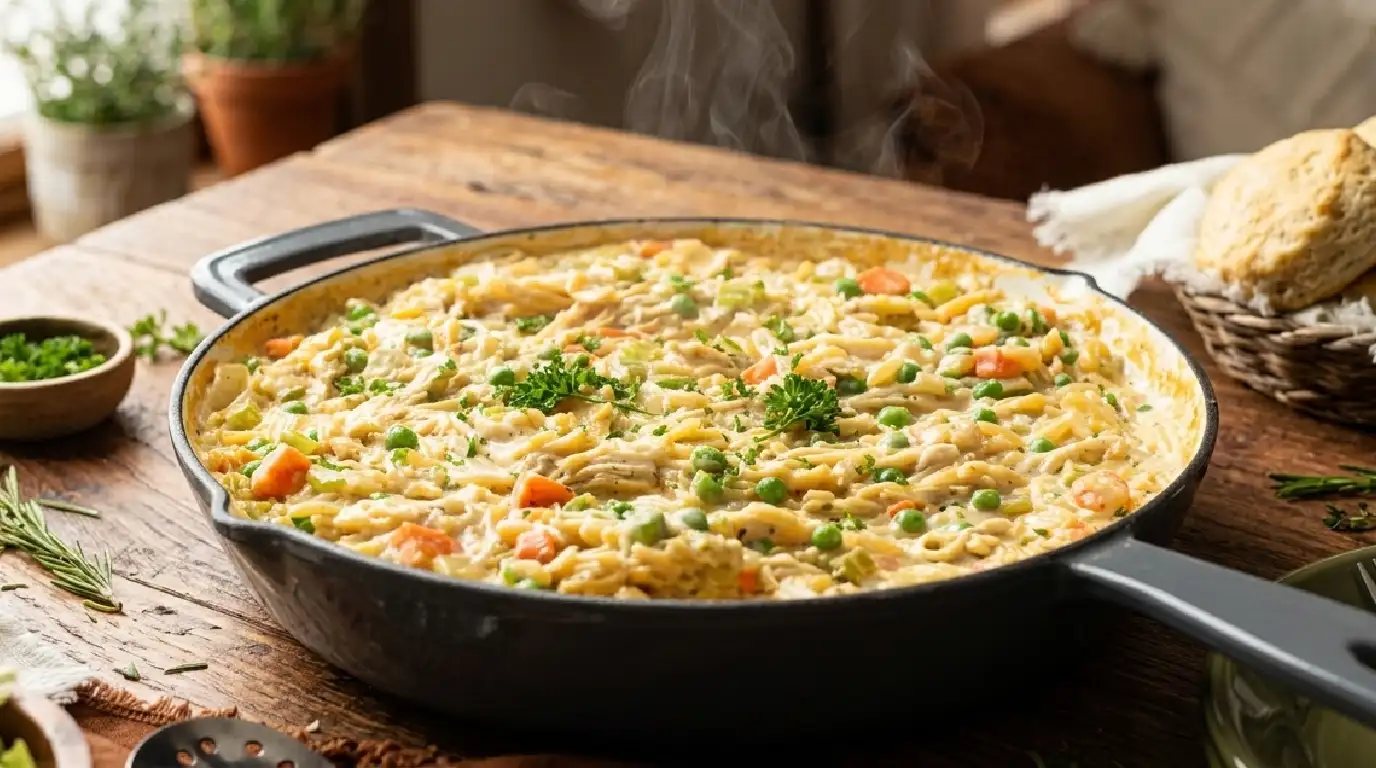
Chicken Pot Pie Orzo Recipe: Creamy One-Pot Comfort in 40 Minutes
Introduction
There is a particular smell that fills the kitchen when butter, onion, carrot, and celery start softening together in a heavy pot. It smells like a Sunday, even on a Tuesday. This chicken pot pie orzo recipe grew out of that smell, and out of a night when I wanted a chicken pot pie but had zero patience for rolling dough.
What I wanted was the filling: the thick, peppery, herby cream sauce, the tender chicken, the sweet pop of peas. So I skipped the crust and let orzo soak up all of it. The pasta cooks right in the broth, releases its starch, and turns the sauce silky and spoonable. One pot, one wooden spoon, and a bowl that tastes like the inside of a pie.
I have made it more times than I can count since. It never fails to quiet a table.
Why You’ll Love This
- It tastes like classic chicken pot pie with none of the pastry work, so you get the comfort without the fuss.
- Everything cooks in a single pot, which means the cleanup is almost nonexistent.
- The orzo thickens the sauce on its own, so there is no separate roux to babysit and no pasta water to drain.
- It uses pantry and freezer staples: frozen peas, broth, flour, dried thyme.
- It reheats well, which makes it a dependable weeknight dinner and next-day lunch.
The Backstory
My brother-in-law Daniel has spent about fifteen years politely pushing peas to the edge of his plate. He says pot pie is “fine, but too much going on.” When he stayed with us last winter, I made this orzo without announcing what was in it. He took a small portion, then went quiet, then went back to the stove for seconds without asking. When he finally spoke, it was to ask if the peas were the secret. They were the same peas he claimed to hate, but they were sweet and tender here, folded into the creamy sauce instead of sitting in hard little clusters. He now texts me for the recipe every few months, as if he might have lost it.
What Makes It Special
- Orzo: The rice-shaped pasta cooks quickly and releases starch as it simmers, giving the sauce a naturally thick, creamy body without heavy cream.
- Chicken thighs: They stay juicy and tender, and when seared first they leave golden browned bits in the pot that become the base of the flavor.
- Butter and flour: A small amount coats the vegetables and gives the sauce that nostalgic, gravy-like richness.
- Onion, carrot, and celery: This trio brings sweetness, earthiness, and a gentle savory backbone.
- Fresh thyme and a touch of sage: The herbs give it that unmistakable pot pie aroma, warm and slightly woodsy.
- Whole milk: Stirred in at the end, it keeps the sauce smooth and mellow.
- Parmesan: A handful adds a salty, nutty depth that rounds everything out.
- Frozen peas: They add bright color and a pop of sweetness against the rich sauce.
Making It Happen
Start by patting the chicken thighs dry and seasoning them generously with salt and pepper. Heat the olive oil in a large, deep skillet or Dutch oven over medium-high heat, then sear the chicken for about four minutes per side until deeply golden. It does not need to cook through yet. Move it to a plate and leave the browned bits in the pot, since they carry a lot of flavor.
Lower the heat to medium and melt the butter into those drippings. Add the diced onion, carrots, and celery with a pinch of salt and cook for six to seven minutes, stirring now and then, until the onion turns translucent and the carrots start to soften. Stir in the garlic, thyme, and sage and cook for another minute, just until the kitchen smells fragrant and savory.
Sprinkle the flour over the vegetables and stir for a minute so it loses its raw taste. Add the dry orzo and toast it for about two minutes, stirring constantly, until a few grains pick up a pale golden color. This small step gives the finished dish a faint, nutty warmth.
Pour in the chicken broth, scraping the bottom of the pot to loosen any stuck bits. Nestle the seared chicken back in, bring everything to a gentle boil, then cover and reduce to a steady simmer. Cook for about ten minutes, stirring once or twice so the orzo does not settle and stick, until the pasta is nearly tender.
Lift the chicken out and shred it with two forks, then return it to the pot. Stir in the milk, peas, and Parmesan. Let it bubble gently for two to three minutes until the sauce coats the back of a spoon and turns glossy and creamy. Taste, then adjust with salt, black pepper, and a squeeze of lemon if you like. Take it off the heat, scatter chopped parsley over the top, and let it rest for five minutes. The sauce tightens up as it sits.
You Must Know
- Do not skip the sear on the chicken. Those browned bits are what make the sauce taste like a baked pie instead of plain chicken soup with pasta.
- Stir the orzo regularly while it simmers. It sinks and sticks to the bottom faster than you would expect.
- Add the milk and peas at the end. Cooking them too long dulls the peas and can make the milk sauce look grainy.
- Let the pot rest for five minutes before serving. The sauce looks loose at first but thickens into a creamy, spoonable consistency.
- Use low-sodium broth so you can control the salt, especially since Parmesan adds its own.
Serving Ideas & Pairings
This is a full meal in a bowl, but something crisp and green balances the richness. A simple arugula salad with lemon vinaigrette works well, as do roasted green beans, steamed broccoli, or a quick cucumber and dill salad. For something heartier, serve it with warm dinner rolls or a crusty baguette for soaking up the last of the sauce.
For drinks, a chilled glass of unoaked Chardonnay or a dry Riesling suits the creamy sauce. If you prefer something without alcohol, sparkling water with lemon, unsweetened iced tea, or a crisp apple cider all cut through the richness nicely.
Make It Different
- Chicken breast: Swap in boneless breasts if you prefer leaner meat. Cut them into one-inch cubes and sear briefly so they stay tender.
- Rotisserie shortcut: Skip the searing, sauté the vegetables, and stir in about three cups of shredded rotisserie chicken at the end.
- Dairy-free: Use olive oil or a plant-based butter, unsweetened oat milk, and nutritional yeast in place of Parmesan.
- Gluten-free: Replace the flour with cornstarch, using about two tablespoons mixed with cold milk, and use gluten-free orzo or small gluten-free pasta.
- Extra vegetables: Add sliced cremini mushrooms with the onions, or stir in diced potatoes or green beans with the broth.
- Crunchy topping: Crush buttery crackers or toasted panko over the top to bring back some of that pie crust texture.
- A bit of heat: A pinch of red pepper flakes or a few dashes of hot sauce gives it a gentle, vibrant kick.
Storage & Reheating
Let the orzo cool slightly, then transfer it to airtight containers. It keeps in the refrigerator for up to four days. Orzo continues to absorb liquid as it sits, so the leftovers will be thicker than when you first made them.
To reheat on the stovetop, add a splash of milk or chicken broth to a saucepan, then warm the orzo over medium-low heat, stirring gently until creamy again. In the microwave, add a tablespoon or two of liquid per serving, cover loosely, and heat in thirty-second bursts, stirring in between. For freezing, it holds up for about two months, though the pasta softens slightly. Thaw overnight in the fridge before reheating, and loosen with extra broth.
Success Tips
- Dice the vegetables to about the same small size so they soften evenly and blend into every spoonful.
- Keep the simmer gentle. A hard boil breaks down the orzo too quickly and can make the dish gummy.
- If the sauce gets too thick before the pasta is done, add a quarter cup of broth at a time rather than pouring in a large amount.
- Grate your own Parmesan when you can. Pre-grated cheese often contains anti-caking agents that keep the sauce from turning smooth.
- Taste before you season at the end. Broth, cheese, and chicken each bring salt, and it is easier to add than to fix.
- Finish with something fresh, like parsley or a little lemon zest, to brighten the creamy sauce.
Frequently Asked Questions (FAQ)
1. Can I make chicken pot pie orzo ahead of time?
Yes. Make it a day ahead and refrigerate it. The orzo will thicken, so stir in a splash of milk or broth as you reheat it.
2. Can I use frozen chicken?
Thaw it fully first. Searing works best on dry, thawed chicken, and frozen pieces release extra water that keeps them from browning.
3. Why is my orzo sticky or mushy?
That usually means the heat was too high or the pasta simmered too long. Keep the simmer gentle, stir regularly, and take the pot off the heat as soon as the orzo is tender.
4. Can I use a different pasta?
Small shapes like ditalini, small shells, or acini di pepe work. Check the package for cook time and adjust the broth slightly if needed.
5. Do I have to use milk?
No. Half-and-half makes it richer, and a mix of milk and a few tablespoons of cream cheese gives a very silky result. For a lighter version, use more broth and a splash of milk.
Recipe Card Info
Prep time: 15 minutes
Cook time: 30 minutes
Total time: 45 minutes
Servings: 6
Category: Main Course
Difficulty: Easy
Cuisine: American
Yield: About 8 cups
Equipment: Large deep skillet or Dutch oven with lid, wooden spoon, cutting board, chef’s knife, two forks, box grater, measuring cups and spoons
Ingredients
- 1 1/2 pounds boneless, skinless chicken thighs
- 1 tablespoon olive oil
- 2 tablespoons unsalted butter
- 1 medium yellow onion, diced
- 2 medium carrots, peeled and diced
- 2 celery ribs, diced
- 3 garlic cloves, minced
- 1/4 cup all-purpose flour
- 1 teaspoon dried thyme, or 1 tablespoon fresh thyme leaves
- 1/2 teaspoon dried sage
- 1 1/2 cups dry orzo
- 3 1/2 cups low-sodium chicken broth
- 1 cup whole milk
- 1 cup frozen peas
- 1/2 cup freshly grated Parmesan cheese
- 1 teaspoon kosher salt, plus more to taste
- 1/2 teaspoon black pepper, plus more to taste
- 2 tablespoons chopped fresh parsley
- Lemon juice, to finish (optional)
Directions
- Pat the chicken thighs dry and season both sides with salt and pepper.
- Heat the olive oil in a large, deep skillet or Dutch oven over medium-high heat. Sear the chicken for about 4 minutes per side until golden. Transfer to a plate.
- Reduce the heat to medium. Melt the butter in the same pot, then add the onion, carrots, celery, and a pinch of salt. Cook for 6 to 7 minutes, stirring occasionally, until softened.
- Stir in the garlic, thyme, and sage and cook for 1 minute until fragrant.
- Sprinkle in the flour and stir for 1 minute. Add the orzo and toast for about 2 minutes, stirring constantly.
- Pour in the chicken broth, scraping up any browned bits from the bottom of the pot. Return the chicken to the pot and bring to a gentle boil.
- Cover, reduce the heat to a steady simmer, and cook for about 10 minutes, stirring once or twice, until the orzo is nearly tender.
- Remove the chicken and shred it with two forks. Return it to the pot.
- Stir in the milk, peas, and Parmesan. Simmer uncovered for 2 to 3 minutes until the sauce is creamy and coats the spoon.
- Taste and adjust with salt, pepper, and lemon juice if desired. Remove from the heat, sprinkle with parsley, and rest for 5 minutes before serving.
Notes
- If the sauce becomes too thick during cooking, stir in broth or milk, a quarter cup at a time.
- Chicken breast can replace the thighs. Cut it into one-inch pieces and sear for 2 to 3 minutes per side so it stays moist.
- For a crunchy, pie-like finish, top each bowl with crushed buttery crackers or toasted breadcrumbs.
- Leftovers thicken in the fridge. Add a splash of milk or broth when reheating.
Nutrition
Estimated per serving (1 of 6 servings): Calories 495, Protein 37 g, Carbohydrates 47 g, Fat 17 g, Saturated fat 7 g, Fiber 4 g, Sugar 6 g, Sodium 710 mg, Cholesterol 125 mg. Values are approximate and vary with the brands and ingredients you use.
I can also put this into a Word or Markdown file if you’d like to download it.
