
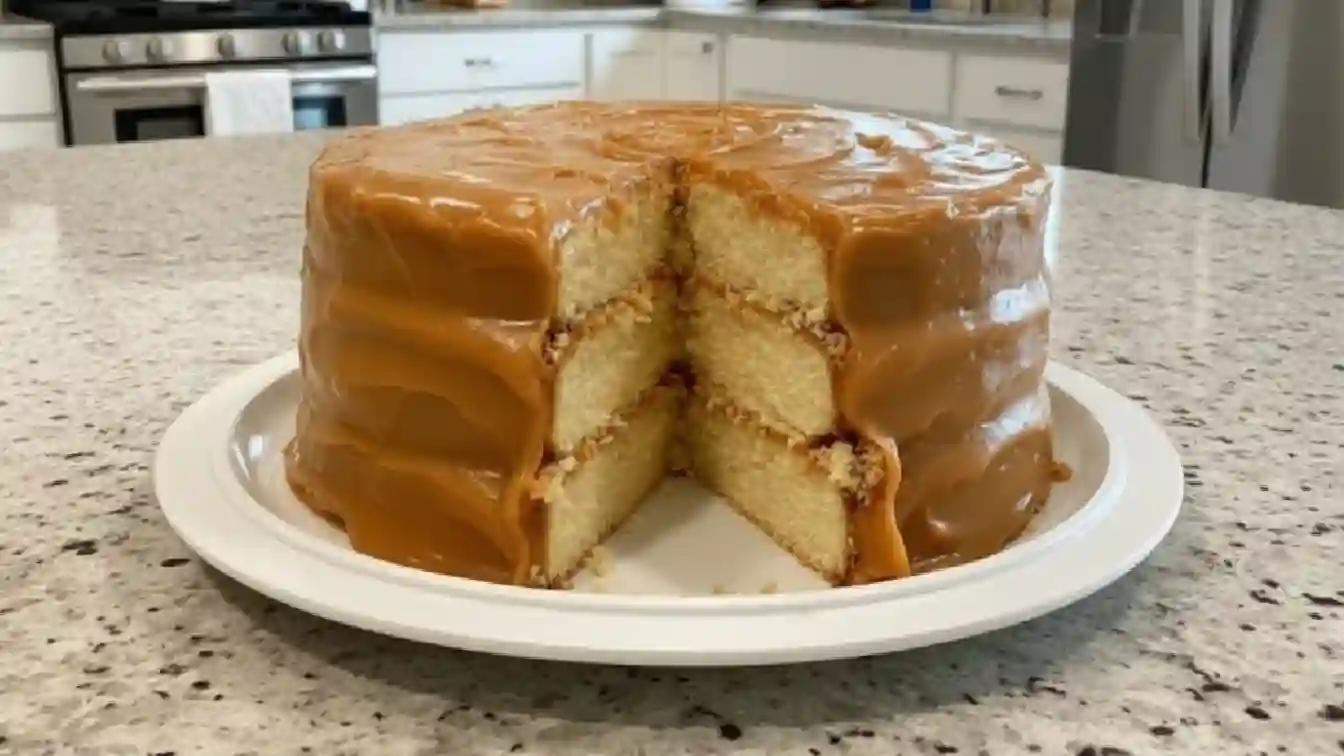
The Best Old-Fashioned Southern Cake Recipe: A Rich Buttermilk and Caramel Classic
There is a specific kind of magic that happens in a Southern kitchen when the scent of browning butter and toasted sugar begins to drift through the house. It’s a scent that signals comfort, celebration, and a little bit of patience. This Old-Fashioned Southern Cake is a tribute to those Sunday afternoons. It isn’t a flashy, store-bought confection with neon frosting; it is a sturdy, tender, buttermilk-infused masterpiece draped in a cooked caramel-style frosting that crackles ever so slightly when you bite into it. Every slice feels like a hug from the past, reminding us that the simplest ingredients—flour, sugar, and cream—often yield the most extraordinary results.
Why You’ll Love This
The Perfect Crumb: The combination of butter for flavor and vegetable oil for moisture ensures a cake that is incredibly soft and never dry.
Deep Caramel Notes: Using both light and dark brown sugar in the frosting creates a complex, Toffee-like depth that white sugar simply can’t match.
Nostalgic Texture: The frosting is a traditional cooked fudge style, which sets into a smooth, slightly firm finish that feels wonderfully vintage.
Balanced Sweetness: The tang of the buttermilk cuts through the richness of the caramel, making it impossible to stop at just one piece.
The Skeptic at the Table
I remember serving this cake at a neighborhood potluck a few years back. A friend of mine, who famously “doesn’t do sweets” and usually skips the dessert table entirely, was hovering near the platter. I watched him take a polite, tiny sliver just to be social. Five minutes later, he was back for a “real slice,” claiming he hadn’t tasted a cake like this since he was eight years old at his grandmother’s house in Georgia. It turns out, even the most dedicated “savory people” can’t resist the pull of real buttermilk and warm brown sugar.
What Makes It Special
Buttermilk: This is the secret to the tender texture. It reacts with the baking soda to create a light, airy lift while adding a subtle tang.
Two Types of Brown Sugar: By mixing light and dark brown sugar in the frosting, we get a beautiful molasses undertone and a rich, golden-bronze color.
Evaporated Milk and Heavy Cream: Using both in the frosting provides a level of creaminess and stability that helps it set perfectly without being grainy.
Room Temperature Ingredients: Taking the time to let your eggs, butter, and buttermilk come to temperature ensures the batter emulsifies perfectly for a smooth finish.
Making It Happen
The process begins with a little preparation. You’ll want to get your oven to 350°F and treat your pans with care, lining them with parchment so those golden layers release without a struggle. While your dry ingredients wait in their bowl, you’ll cream together the butter and oil. It might seem unusual to use both, but the butter provides that classic Southern flavor while the oil guarantees the cake stays moist for days.
Once you’ve beaten in your sugars and eggs until the mixture is pale and fluffy, you’ll begin the rhythmic dance of adding the dry ingredients and the buttermilk. Start with the flour, follow with the milk, and repeat. This gradual process keeps the batter smooth. After a short stint in the oven, your kitchen will smell like vanilla heaven.
The real excitement begins with the frosting. In a saucepan, you’ll melt the butter and sugars together until they become a bubbling, molten amber. After simmering with the cream and evaporated milk, you’ll whisk in the powdered sugar. This is where speed becomes your friend. You have a short window of time to spread that glossy, warm frosting over the layers before it begins to set into its signature fudge-like consistency.
You Must Know
Watch the Clock: When simmering the frosting, stick to the 4-minute rule. Too short and it won’t set; too long and it may become crumbly.
The Sift is Key: Always sift your powdered sugar for the frosting to ensure there are no stubborn white lumps in your beautiful caramel finish.
Level Your Layers: If your cakes have a slight dome, use a serrated knife to level them off. A flat surface makes the frosting process much easier and looks more professional.
Serving Ideas
This cake is a showstopper all on its own, but a dollop of unsweetened whipped cream or a handful of fresh pecans on the side adds a nice textural contrast. For a drink pairing, a strong cup of black coffee is the traditional choice to balance the sweetness of the caramel. If you’re serving it in the evening, a small glass of bourbon or a cold glass of whole milk is equally delightful.
Make It Different
The Nutty Version: Stir a cup of chopped, toasted pecans into the frosting right before you apply it to the cake for a “Praline” style finish.
Spice It Up: Add a teaspoon of cinnamon and a pinch of nutmeg to the dry ingredients for a warm, autumnal flavor profile.
Gluten-Free: A high-quality 1:1 gluten-free flour blend works surprisingly well in this recipe due to the moisture from the oil and buttermilk.
Storage and Reheating
Because of the oil in the batter, this cake stays moist for a remarkably long time. Store it under a cake dome or in an airtight container at room temperature for up to three days. If you prefer to keep it in the fridge, it will last up to five days, but let it sit at room temperature for 30 minutes before serving so the frosting softens slightly. I don’t recommend reheating the whole cake, but a five-second zap in the microwave for a single slice can make the frosting delightfully gooey.
Success Tips
Don’t Overmix: Once you add the flour, mix only until the white streaks disappear. Overmixing can lead to a tough, dense cake.
Temperature Matters: Ensure your buttermilk isn’t ice-cold from the fridge. If it is, it can cause the melted butter in the batter to seize up.
Fast Frosting: Have your offset spatula ready. Once that frosting hits the cool cake, it starts to firm up quickly. Embrace the “rustic” look if it sets faster than you expected—it’s part of the charm.
Frequently Asked Questions
Can I use regular milk instead of buttermilk?
In a pinch, you can make a substitute by adding a tablespoon of lemon juice or white vinegar to a cup of milk and letting it sit for 5 minutes. However, real buttermilk provides the best flavor and texture.
Why did my frosting turn out grainy?
This usually happens if the sugar wasn’t fully dissolved during the melting stage or if the powdered sugar wasn’t sifted. Make sure to whisk constantly while melting the butter and brown sugars.
Can I make this as a sheet cake?
Yes. You can bake this in a 9×13 inch pan. It will likely need 30-35 minutes in the oven. Just pour the frosting over the top while the cake is slightly warm.
Why is my cake sinking in the middle?
This often happens if the oven door is opened too early or if the baking powder/soda is expired. Check your leavening agents for freshness every six months.
Do I have to use dark brown sugar for the frosting?
You can use all light brown sugar, but the frosting will be lighter in color and have a milder flavor. The dark brown sugar adds that essential “old-fashioned” depth.
Recipe Card: Old-Fashioned Southern Cake
Prep time: 25 minutes
Cook time: 28 minutes
Total time: 2 hours 53 minutes (includes cooling and setting)
Servings: 12-14
Category: Dessert
Difficulty: Medium
Cuisine: Southern American
Yield: One 2-layer 9-inch cake
Equipment: Two 9-inch cake pans, parchment paper, stand mixer or hand mixer, medium saucepan, electric hand mixer (for frosting), offset spatula.
Ingredients
The Cake
2 ⅔ cups all-purpose flour
2 teaspoons baking powder
½ teaspoon baking soda
½ teaspoon salt
½ cup unsalted butter, softened to room temperature
½ cup vegetable oil
1 cup granulated sugar
¾ cup light brown sugar, packed
4 large eggs, room temperature
1 tablespoon vanilla extract
1 ¼ cups buttermilk, room temperature
The Frosting
1 cup light brown sugar, packed
1 cup dark brown sugar, packed
1 cup unsalted butter, cut into tablespoons
½ teaspoon salt
⅓ cup evaporated milk
⅓ cup heavy cream
2 cups powdered sugar, sifted
1 teaspoon vanilla extract
Instructions
Prep the Station: Preheat your oven to 350°F. Lightly spray two 9-inch cake pans with baking spray. Line the bottoms with parchment paper and give the top of the paper another quick spray.
Whisk Dry Ingredients: In a medium bowl, stir together the flour, baking powder, baking soda, and salt. Set this aside.
Cream Butter and Oil: In the bowl of a stand mixer fitted with the paddle attachment, blend the softened butter and vegetable oil until combined.
Incorporate Sugars: Add the granulated and light brown sugars. Beat on medium speed for about 3 minutes until the mixture looks light and fluffy.
Add Liquids: Mix in the eggs one at a time, ensuring each is fully incorporated before adding the next. Stir in the vanilla extract.
Combine Batter: Add half of your dry ingredients and stir until just combined. Pour in half of the buttermilk and stir again. Repeat with the remaining flour and buttermilk, scraping the sides of the bowl to ensure everything is even.
Bake: Divide the batter equally between your prepared pans. Smooth the tops with a spatula. Bake for 22–28 minutes. A toothpick inserted into the center should come out clean.
Cool: Let the cakes cool completely in their pans. Once cool, level off any domed tops with a knife so the layers sit flat.
Prepare Frosting Base: In a medium saucepan over medium heat, combine both brown sugars, the butter tablespoons, and salt. Whisk constantly until everything is melted and smooth.
Simmer: Whisk in the evaporated milk and heavy cream. Bring the mixture to a simmer and let it bubble for exactly 4 minutes, whisking occasionally as it thickens.
Finish Frosting: Immediately pour the hot mixture into a heatproof bowl. Using an electric hand mixer, gradually beat in the sifted powdered sugar until smooth, then stir in the vanilla.
Assemble Fast: Place the first cake layer on your platter. Spread about ¾ cup of frosting over the top. Place the second layer on top (flat side up). Quickly frost the top and sides of the cake before the frosting firms up.
Set: Allow the cake to rest for at least 2 hours until the frosting has hardened completely before slicing.
Notes
Measurement Tip: For the flour, spoon it into your measuring cup and level it off with a knife. Packing the flour can lead to a dry cake.
Frosting Consistency: If the frosting hardens too much in the bowl while you are working, you can add a tiny splash of warm heavy cream to loosen it back up.
Nutrition (Per Serving)
Calories: 645 kcal
Fat: 32g
Carbohydrates: 88g
Protein: 5g
Sugar: 68g
